
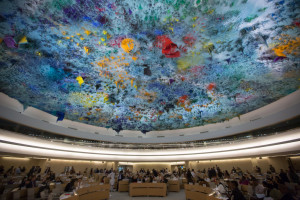
In a remarkable vote on October 16th, the Democratic Republic of the Congo (DRC) was elected a member state of the United Nations Human Rights Council, the branch of the United Nations responsible for promoting and protecting human rights across the world. Despite its appalling track record with human rights, the DRC received 151 of the 193 votes cast by the UN General Assembly. This election has left many, including US Ambassador to the UN Nikki Haley, concerned about the legitimacy and credibility of the Council as well as the strength of global efforts to prevent human rights abuses. The ability of the DRC to join the Council is attributable to the widespread culture of complacency and overall lack of accountability that plague our world.
Until late December of 2016, when a peace treaty was signed, the DRC was two years deep in political conflict that left many civilians vulnerable to abuse. In fact, the UN Human Rights Office reported that 64 percent of the over 5,000 human rights abuses that occurred that year were committed by the Congolese army and police. The UN Human Rights Council even wrote a letter to the President of the DRC, Joseph Kabila, demanding that stronger efforts be made to combat and report out on human rights abuses in the country. While the treaty was signed in December, the country has not yet enforced a comprehensive reform plan to address human rights abuses. Many are concerned that adding the DRC to the UN Human Rights Council sends the wrong message and allows the country to maintain the status quo rather than work towards higher human rights standards.
For others, the concern is not only about the DRC, but also about all other countries perpetrating human rights abuses. Notably, Venezuela, Burundi, and Saudi Arabia are all serving terms on the Council. By including the DRC on the UN Human Rights Council, the credibility of the Council is undermined, as is its ability to hold abusers and violators of human rights accountable.
With these consequences and recent human rights abuses at the forefront, many leaders were quick to criticize the decision. Ambassador Haley said in a statement that “countries that aggressively violate human rights at home should not be in a position to guard the human rights of others.” Louis Charbonneau, UN Director at Human Rights Watch, called it a “slap in the face to the many victims of the Congolese government’s grave abuses.”
The culture of complacency at the UN is troubling, especially when noting that many power struggles lie at the root of human rights abuses, including in the DRC. Recent history has proven that a stable power structure and strong, credible leadership are critical to ensuring the preservation of people’s rights. In Burundi, political conflict has flooded the streets with blood and left refugees with wounds as deep as the divisions in the region. In Sudan, a quest for absolute political control has left the government standing on the tenets of murder, assault, and repression. In Yemen, Saudi Arabia’s coalition has violated laws of war, causing famine and halting aid delivery by blockading all ports of entry.
The world needs stable leaders who are willing and capable to take on the responsibility of protecting human rights across the globe rather than simply posturing. The UN Human Rights Council is meant to be a group comprised of such individuals from around the world. Their mission is to help preserve human rights, but that cannot be done if their integrity is not maintained in the public eye. It is crucial that stricter rules and standards regulate elections to the Council. With the election of the DRC, a country that is a prime example of why the world needs the UN Human Rights Council, it is time to reevaluate the member selection process. It is long past time to make human rights a genuine priority.
–

Mira Mehta is a writer and a student at Westfield High School. In her spare time, she enjoys debating and running on the cross country team. This is her first year as a member of the Communications Task Force at STAND.